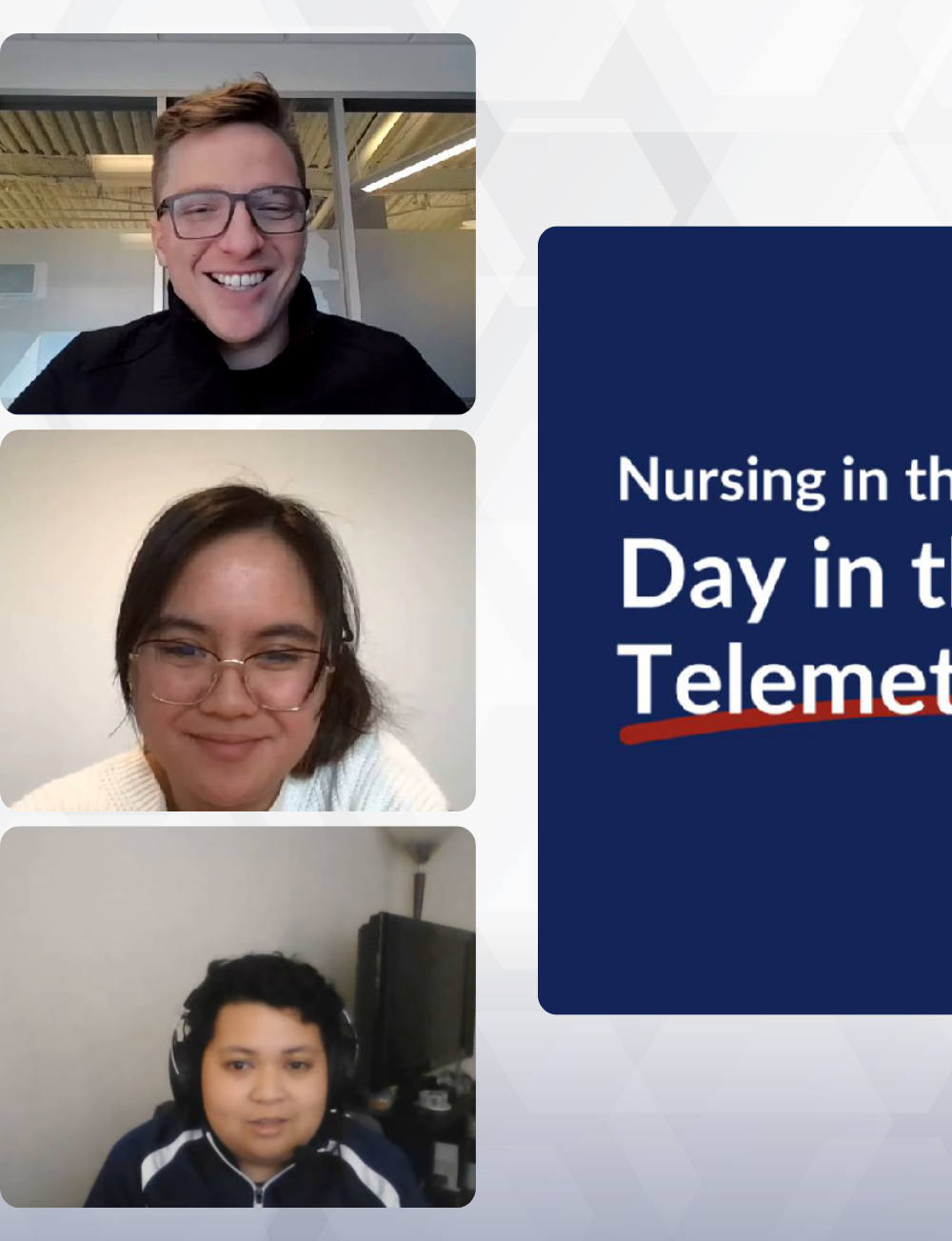
Inside A Telemetry Shift In the USA
The Resource Center content, including all videos and other media, is for informational purposes only. You should not construe any such information or other material as legal, tax, investment, financial or other advice. The advice and information contained in the Resource Center is not a substitute for advice from a professional who is aware of the facts and circumstances of your individual situation
I am joined here today to have a conversation with a couple of our peers working here in the United States.
Really looking forward to today's conversation because this specialty requires very strong clinical skills, teamwork, and adaptability, and hearing from someone who's doing the work right now is one of the best ways to prepare. And so everyone, please join us in welcoming Jasmine and Anna.
Hi everyone, good morning.
Hello everyone.
Good morning, thank you for taking some time out of your days. I'm very, very happy to have you here with me today to help provide feedback and insight to your peers and nurses wanting to embark on their journey to become a nurse here in the United States, and so just to kind of help everybody get to know you a little bit more, I'll start with Anna, because you're first on my screen here. Tell us a little bit about, I guess, your journey that, just in a quick high level summary, that took you to telemetry nursing here in the United States.
So I came with our current client on May twenty twenty three, and everything is a general, like when you say telemetry.
I've been working there since, yeah, May twenty twenty three, and currently, I'm about to, like, finish my contract so far.
Very cool. Jasmine, how about how about yourself?
How about me? We're initially, when I got the interview for this facility when I was still in the Philippines, because I was an ER nurse way way in the Philippines. That's why that is my experience. But at some point of like when I was no, before I came here like a month before they say, you know, because of not availability of that position, they opted to put me on a telemetry unit
But they haven't said anything about what kind of unit it is. I think they just said like a med surg telemetry.
But after like quite some time, I've been floated to a different unit, a step down or even any med surg unit that I could work on.
Yep.
Gotcha. Yeah, it's definitely both of you sound to have what would be considered transferable skills to the telemetry environment, and really I think the biggest differentiator on what your telemetry unit looks like here in the United States is I think a lot of it based on the size of your facility. Right, larger hospitals are able to specialize a lot more, maybe offer a step down unit that is separate from say like a remote telemetry unit. Or if you're working in a much smaller hospital, where the number of units is more limited, they have to become a little more multifaceted and able to maybe accommodate different levels of acuity within one unit. So with that, you know, kinda the telemetry area focusing primarily most of the time on, your cardiac patients, the cardiac needs, and those patients that are having their heart rate rhythm all monitored through that remote cardiac telemetry.
And so it really has grown in the past decade or so as the acuity of hospitals has increased.
And so very casual conversation here today, I'm gonna kind of just bounce back and forth, you may not each answer both the same question. If you have feedback, maybe to build on somebody else's answer, please do chime in again, very casual conversation here today. And so, Jasmine, kind of walk us through what a typical shift would look like for you on telemetry unit working with those patients.
Okay. So initially they usually do a huddle on change of shift. They might do it on the morning as well as the night shift when it's time for, you know, swapping with the day shift and night shift thing? They usually come up with whatever reminders they want us to have and, you know, some updates on the facility or protocols that we have to follow or some changes.
After that one, I usually they usually assigned some rooms that we are going to have. So, our unit is it doesn't, how do they, okay, so they assign patients not by, you know, like by rooms, they usually like assign it with the equidity of, you know, how this patient would be throughout your twelve hour shift, it's going to be busy, you know, that's how they arrange it. So you get sometimes you get the same room that's closer, but sometimes you get, you know, like a spread out numbers of patients. So it's a whole lot of walk and working.
It's really a big difference on how do, I mean, how nurses work here compared to the Philippines, it's way different.
Because in here you're more of like really the primary, like you have to do a whole lot of things for patient, only medication, not only you know doing nursing responsibility, but as well you know helping patients get involved with their care and being advocate. Guess here the only you know way back you're still in the Philippines you are also like advocate, but in here you're like more involved with patient, not only with the patient, also his patient's family and everyone that's involved in their care. So they usually do that as like an assignment for us. Then what else?
What I typically do is if I've already signed patients, I'll find a nurse who has them, get report. I usually come in with the nurse that's had them on daytime and that way they could you know meet me before sitting down and looking at the chart because you know the busiest time is the shift change and a lot of problems or accidents sometimes happens during shift change because everybody is busy, know, like a lot of stuff happening, especially on the shift change. So I usually just go with the nurse, gave me a report, go into the room, you know, just to make sure patients is safe, you know, and there's no other concern that I have to raise, I mean, they have to do or address right before I can come back to them, like, maybe an hour to see them again.
So I usually do that, and once I get report and sit down, I look at the chart, verify the orders, what I need to be done throughout the day, and just basically see what are their meds, what whatever a morning nurse said that he hasn't he or she hasn't done that I could continue is that is the number one I'm checking because you don't wanna miss that. But, you know, like I said, not everything you can be done within the twelve hour shift. You might feel like you haven't done anything, but, you know, it's twelve hour shift. You can only do as much.
And first thing is a twenty twenty four hours job. So don't be I know some of you will be, like will be hard on yourself for not doing a whole lot. You feel like you don't, you're doing a whole lot, but believe me, you've been doing a whole lot more.
So for my advice, that's how I do it.
See chart and then, know, once I'm done looking all the charts and that's how I'm to do my whole day. If something comes up, going to get a new admission and all that the same thing, the charge nurse in there, they're going to help you. I'm not sure how other facility does, but on us, they would help me set up a patient, you know, especially when if it's submission, you got to ask a lot of stuff related to their admission. So you're going to reach out family members that's not in there, maybe through phone or from a facility where they came from.
And on the end of the shift, I usually do shift summary. They said you can skip up doing a shift summary, but for me it's already like ingrained on me that I usually do some shift summary because that's a very important one that the doctor could look at in case, you know, there's like a discrepancy on care or who's going to be, you know, take responsibility. So for me, you have to do your end of shift summary as always, like, even though the your shift wasn't as you know, it was fine and nothing happened, for me, you still have to do it.
And I guess that's all, I make sure at five a. M. That all my patients are cleaned up, I go rounds every two hours as if I'm not that busy I go rounds every time even though if they haven't done I mean if even though they're sleeping you could just sneak out in there through dark just to make sure because you might never know because I've experienced patient that's out of nowhere just you know could not wake up and had to call a rapid response to them.
So if you haven't been checked for a couple of hours, please make sure do check your patient because a lot of people don't I'm not saying but then this is a reality, a lot of nurses do that. Some people just give meds and won't go back for a couple of hours. So please don't do that to your patient.
Please don't do that. So I always wanna do that rounds patient, make sure they're all cleaned up. Whoever's gonna get a procedure on the morning, I make sure to give them bath, give them, you know, keep them in remind them that they don't they cannot eat or drink. That's especially that is very specific to what yeah. Mostly. So I do that, do my shift summary and update my report sheet, and that's all. Whatever comes up there if they need me I'll help someone and I guess that's how my day works.
Yeah that's all right that's all nurses do and definitely a lot to it, and you made a lot of good points there, and just to highlight, not every hospital is the same, The United States is so large and different health operate, but a lot of them are shifting towards what you said at the beginning of acuity based assignments versus just where you're located.
Regular load base.
Right, trying to not give everybody the high, we don't wanna stick all the highest, most sick people with one nurse, because that obviously would be a patient care risk, and make that very tough on that patient assignment. It's a song and dance the charge nurse and the leaders do to try to divide up those patient assignments fairly.
Second great point you made, right, you only have twelve hours in a shift, it's hard. It sounds like a long shift, but boy does it fly by when you're busy.
If you think through like a four patient telemetry assignment, four to five, that's only about three hours in total. If you were to divide all your time evenly across the board with all your patients, like three hours. So that's really not a ton of time, and so you're very busy and trying to of stay on top of things, and I think you did a fantastic job highlighting that and sort of giving that a picture for people to imagine.
And then sort of lastly, to kind of reflect on one of the things you said, the advocacy, the voice that the nurse plays and the role that you have as a nurse in the United States.
I know that can be a challenge, I'll say I've never met a shy nurse.
I've met nurses and my friends, people I went to school with when I was in nursing school who was shy, and some people would argue and not believe it, I used to be a very quiet and shy person myself.
Nursing sort of requires you to take that and put it off the side in the work environment there to be an advocate, to be involved in the patient's care, to educate the patient, speak up for the patient, and communicate to your healthcare team.
A lot of great points that you made there, And so I'm gonna direct my next question over to Anna.
So in terms of working with patients on remote telemetry, how does telemetry monitoring factor into your daily responsibilities?
So when I come like into the unit, with our telemetry, we are expected or part of our training is to interpret EKGs on a daily basis.
Being able to discern afib from a stable afib, from a Vtech to a Vfib Those are one of the things that we are being taught to look for and we need to have a keen eye because in my unit for example we have a monitor at the entrance of our unit, there is a TV and it has all the EKGs of the patient and in the station, two of the stations are like, they have big monitors even just along the hallway we have to, like, flip our head just to take a look at the EKGs. If it if it even if it's not our patient and we see something, we have to go in, assess the patient.
And that is something new for me because in back home, the monitors are only in the station You don't see it in the hallway So I've I got used to the to the scenery where people are just, like, running into the room after just walking by the hallway. And we also have to run with them, and we also have to assess the patient and, things like that. We are they make an emphasis to us to be, compassionate and at the same time be alert and try to help out with each other as much as you can, even if it's not your patient.
It's one of those things that were ingrained to us during our training.
And even with the EKG, we are quite I was fascinated by it because everything here is like portable. You get transferred to a patient, you transfer them, you have a portable monitor, you do EKG on the spot, even the techs, they know how to do the EKGs.
So it's not just us nurses. We collaborate with them.
And what else? For yeah. We do get they do emphasize also with alarm fatigues, learning how to manage through them, even just a small alarm on the monitors, we have to take a look, assess the patient.
I've also tried so since I have a background with the step down ICU, I've also volunteered to be a telemetry tech on the hospital where I would just watch two huge monitors and I just have to call the nurses and inform them about it. So those are one of the things that was a bonus for me because I didn't really need to undergo an additional training once they find out that I'm a telemetry nurse. They just let me sit on that and watch the monitors and just notify them.
And it's also quite daunting in here.
We're not as familiar with pulmonary embolism in the Philippines.
It's one of those things that we will only find out after a CT or an imaging But in here, with the symptoms, with everything so portable We are actually able to be a step be step ahead for the patients and give them a timely management.
So that's one of the things that I had to get used to, and I also had to keep up with my colleagues on the EKG reading.
Slowly, they were, like, teaching me on how to read just a six strip EKG to figure out which ones are heart blocks.
And so if you're trying to if you're gonna be a telemetry nurse here, I think it would be a best option to really invest your time to learn the strips, how to read heart blocks, and stuff like that in management also.
It it's a big step, especially you especially when you're you're on your own. It and you hear all of the alarms and everything, but you're able to see what to watch out for. So yeah.
Yeah, definitely a lot of reprioritization that occurs and being prepared as you go up in acuity, more critical patients, the reassessment factor does play into where it is much more frequent and important, especially for like the telemetry patients where a lot of the medications maybe that they're receiving can require some form of pre assessment or post assessment based on the facility policy. So kind of tell me a little bit, I'll kind of kick back over to Jasmine here, because of that, the constant reassessment and assessing the patient, how do you go about prioritizing your tasks during a busy shift?
So I guess a busy shift, I made it a habit to arrive at least thirty minutes early at work I have this practice where I have to see the patients, take a look or see their chart ahead of time.
And that's when I can anticipate when who will I need to prioritize in terms of management. Who needs to go to a city, who is ambulatory, who needs who can be managed less. So those are the things that I've taken into account.
And when I do have a busy shift, I give the charge nurse a heads up.
Our charge nurse, they really have to partake in helping us out.
Or I we have, this body system where one of the nurses is your bodies, or they will take over if something is happening or what.
I try to let them know what's happening with my cases so that they can help me out, or I can delegate some of the tasks.
And I try not to take everything on my shoulder at work. I really have I had to learn how to properly delegate since there are things that, like, special LPNs, techs, they all have their roles, we had to really utilize or or work with them so that our our period or our shifts won't be as heavy as much.
So yeah.
Jasmine, did you have any additional feedback in terms of, I know we mentioned before the patients and the amount of time, right, that you have only twelve hours, so time management prioritization are a must for nurses. Did you have any strategies or prioritization advice?
Actually, just sounded like her because you have to let your charge nurse or anyone that could help you during that shift because you need you know, you cannot do it all all alone.
What if, you know, the the basis is if your patient is that it's not only one patient that you're gonna, you know, gonna come through with a problem. So most of the time, if this patient comes to be worse, the other one might as well. So that's how it is. I don't know why, but it does comes in twos. That's what they said. So I usually let the charge nurse know about the situation, and that way they could help me. That's how I do usually.
Because like what she said, you cannot do it all alone by yourself and you have other people that could help you. I think it's another like adjustment for everyone, like a new on USA that's working on a hospital that we're not used to have like a backup, you know, that could help us do this stuff.
Because I mean, from where we came from, we don't have other nurses, you know, capable nurses that could also do it. Like like what she said, like, how to delegate tasks and all that.
It's so different.
We learned the statement. It's a day shift problem.
We had to adjust to that kind of term. It's a night shift problem. It's a day shift. At the moment, the time hits seven or six or six thirty, you really have to let go, and you really just have to accept the result of what you had what you could have done within the twelve hour shift.
Right. Right. Yeah. Definitely, teamwork makes a dream work. Know that's like the corniest phrase ever said, but it is true though, especially within healthcare and within nursing specifically that where the stakes are high, where there's the common goal of the professionals working there for the patient center care, we must work together, right? The best facilities are ones with a strong team environment within their units, and that's what so many hospitals strive to develop.
So I know we're coming short on time, I got two more questions I wanted to kind of throw out there.
So Anna, what skills do you feel other than the teamwork, the collaboration that we mentioned, the prioritization, EKG interpretation being a must, what other skills do you feel are most important to be a successful telemetry nurse?
I think good communication and having a set of basic fundamental skills in nursing.
And when I say the basic fundamental skills, IV insertion, NGT, Foley, those are the things that you really have to master.
Or not really master, be proficient enough to do.
Because time will come that you have to do it on your own, and you can only get, like, a small assist. And you'll be surprised that in the unit, you're actually more experienced than you think. You have more knowledge compared to other nurses, and it's just really polishing your skills and also learning how to communicate.
I know some of the Filipinos were don't they're they are quite intimidated with talking in English, trying to adjust with the accent. Jasmine already has the southern accent. I can hear it from her. So I'm kinda like yeah. Now. Yeah. So it's one of those things that we had to you need to learn being able to express yourself or being able to express yourself and learning to, like, say no when things are really getting hard.
So yeah.
Absolutely. Jasmine, were there any additional skills that you feel are really a must?
Yeah, for me I could just add it to it. Maybe just you know, like it's the same thing for her, but for me on the attitude side, I think for me when you come in here of course it's gonna be overwhelming with a lot of stuff that you have to adjust to, but you have to be open you know. A lot of people are not comfortable having a change of environment. I know I get that, but for you to be able to transition here successfully in the US you have to be and have an open mind And you know, just be a sponge that you could absorb whatever knowledge that you may gain on transitioning here.
I think that's the number one thing that you should have is having an open mind to learn a whole know a whole new thing and a whole new knowledge that you could utilize because I think if you don't have any of that's the other thing if you don't have it you're gonna be having trouble like adjusting to a whole new kind of work while you're here. So I suggest that starting as now you have to like mentally prepare yourself that it's it's going to be a big change on how you do how you used to be but as soon as you already like get a hold on it, it'll be easier. It'll be easier for you. So I have to have that one.
Awesome, awesome. And then finally, just real quick, what is your favorite or what do you find most rewarding about working in the telemetry environment?
For me, the most rewarding would be the opportunities ahead Because I see, working in a telemetry unit, it's either you go ICU or you go down to a medical med surg ward So you're in between and there's a lot of options for you to go to You can specialize, you can focus on one craft, you can focus on one unit aside from that, I think the most rewarding is also when you're recognized by your peers for even the simplest things to do or the simplest acts. It really helps boost the confidence. And believe it or not, they really, they really encourage you or they really reward you for the compassionate care that we can give as a nurse For most of the patients here, they're quite amazed or surprised at the quality of care that they get from foreign nurses They give high praise and it lifts the spirits up, especially at a very heavy unit.
Jasmine, did you have anything that you wanted to add about rewarding?
I guess not. I think it depends on how you know if it's how they you know would like to be fulfilled on this kind of job because this kind of kind of job alone requires you know being selfless to people. Mean and for me when before I even became a nurse I've been prayed for like having a mission in life that I love to do so I guess helping people enough for me is a fulfillment in life, but of course seeing your patient get better get discharged when you hounded them is a success and a fulfillment on my part.
On excuse me. On career side, of course, you know, that means you are a reliable nurse. That means you are are doing your job because you've done your part. I guess that's I can't I guess that's all I need to feel to get fulfilled. That's on me.
Yep.
Oh, no.
Not much.
No. It's sort of something to think about, right, and and definitely leaves you, you know, reflecting on it. And so these segments are always my favorite, I love the day in the life segments where we get to speak to our nurses that are working at the end of the road, right, sort of where you're trying to get to, and sort of boots on the ground working in the thick of it and to learn and to be able to share that knowledge to individuals who are just starting their journey, I find super invaluable and super helpful, and so it's always my favorite thing to do to sit down and have these conversations for the benefit of everyone. So thank you so much, Anna and Jasmine, for your time here today, and we'll talk to you again soon.

Related Resources

How To Become A Stronger Candidate For Future US Opportunities

How To Become A Stronger Candidate For Future US Opportunities
Keep Exploring More Resources
Looking for more guidance? Browse our full collection of resources to support you throughout your journey.
.webp)
.webp)