A Nurse’s Advice for Your U.S. Nursing Facility Interview
The Resource Center content, including all videos and other media, is for informational purposes only. You should not construe any such information or other material as legal, tax, investment, financial or other advice. The advice and information contained in the Resource Center is not a substitute for advice from a professional who is aware of the facts and circumstances of your individual situation
Summary:
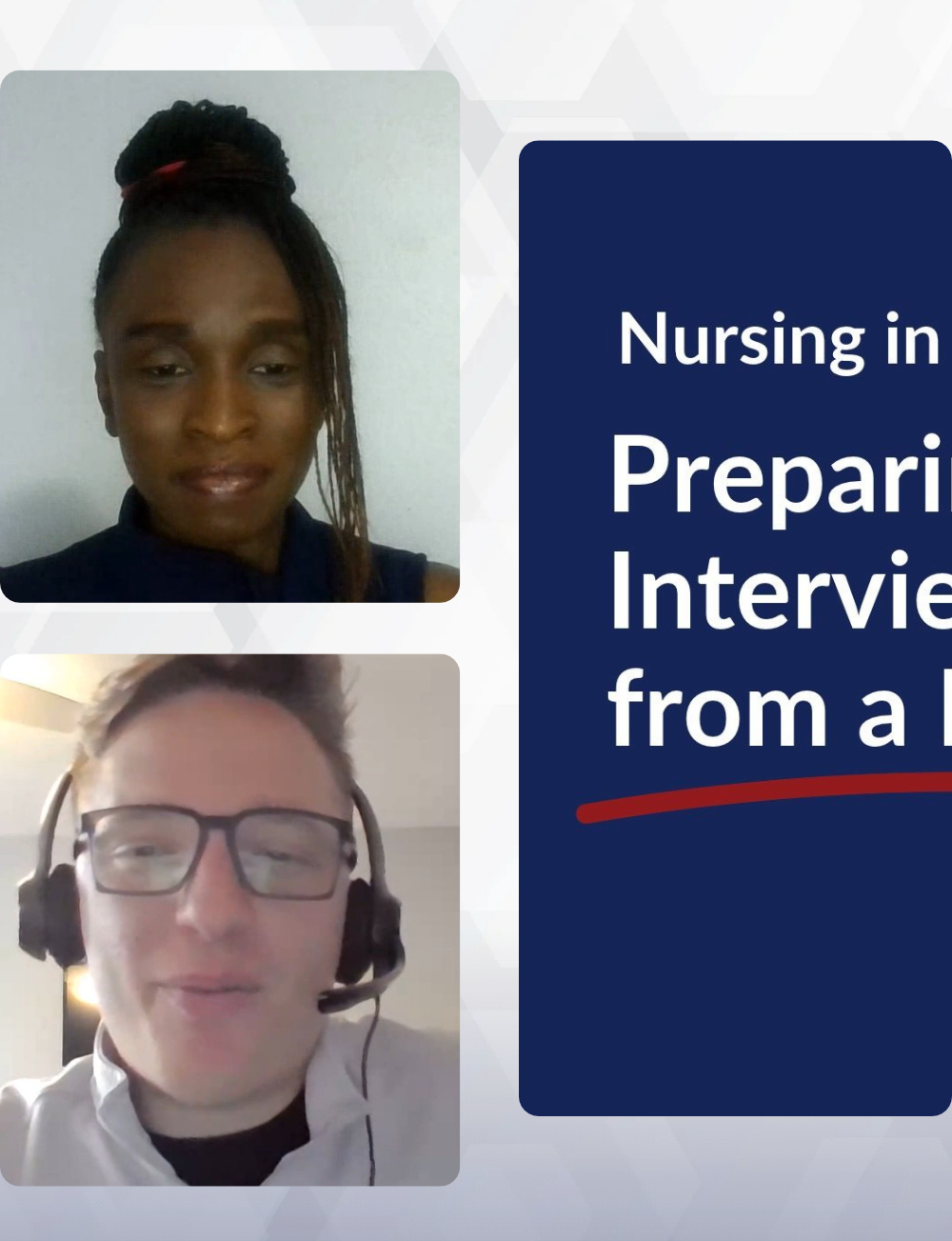
How can you feel more confident and prepared when interviewing with a U.S. healthcare facility? In this resource, Health Carousel International sits down with an international nurse to share firsthand insights from the U.S. interview experience. Learn how practicing common interview questions, drawing from your real clinical experiences, researching a facility’s values, and preparing thoughtful questions can help you communicate your skills clearly and approach your interview with greater confidence.
Transcription:
Hi, everyone. It's Ryan here, quality improvement nurse here with Health Carousel, one of the clinical support team members. And I am joined by Sharon, who is one of our working nurses here in The United States.
Very happy to have you here today, Sharon.
Thank you, Ryan. It's nice to see you.
Absolutely. I'm always so excited to, get to talk to our professionals. Really, in these instances, on, big topics that we are wanting to review, to share, and hopefully help out our nurses and other health care professionals who want to journey here to to The United States. And today's conversation really wanted to focus in on, the interview process, getting your insight and feedback on, you know, how did interviews go for you, and, you know, maybe some advice that you can pass on to future health care professionals looking to, bring their careers to The United States and prepare for those interviews with United States health care facilities.
Yeah. It's a it's a... Thank you for giving me this opportunity to hear... To share my experience with other people who are coming here.
I was once there, and, it was kinda a a time to to prepare and looking forward to the future.
And so, during the interview, do you have any specific questions for me for signing this interview?
Yeah. So I was just gonna say, if you could just briefly introduce yourself, and maybe describe your health care background that you had prior to, coming to The US and maybe, you know, what, what area are you focused in specialty wise with your nursing practice now?
Oh, thank you. Right now, I work with, the behavioral unit, which is the psych unit.
And I've also worked in MedSurg. That way... That was where I actually started when I came into The US, and I've I've worked there for for over a year. And right now, I'm almost a year in psychiatric unit, and and I'm enjoying everything.
That's awesome. Awesome. So maybe not necessarily, what your background was specifically in, but kind of a a leap into something new for you, which, you know, congratulations. Right? That's huge to to kind of make that transition. And so when you were getting ready for your interviews, how did you prepare for an interview with a US health care facility?
And sort of what strategies did you find to be the most helpful?
When I was preparing for this, thanks to Passport USA, they always have, like, a guide for you to go through, and I made sure I used that. And I went to YouTube. Thank god for the global village that we have now. So I went to YouTube to see what could help me, what could guide my own way of understanding, and it actually helped me a lot. Like, information from YouTube, I got... I grabbed everything that I could, and it was actually helpful.
Yeah. No. Absolute... Absolutely. I think, you know, interviews are a a art form in in in itself, You know, the... I always tell candidates the best interviewers are people who have done many interviews. It's, I think, something that can be underestimated a little bit.
And I think practicing, like you you mentioned, right, sourcing resources, we will always support and provide support from the PassportUSA Health Carousel side with interview preparation, coaching, and resources as well. But, you know, I don't think you can practice too much. It helps you to get into the flow and cadence of answering questions.
And that way, you're not caught off guard when you eventually get to that interview.
But I I think you you hit the nail right on the head in in terms of, you know, preparing ahead of time, whether that is watching people interview on on YouTube or answering practice questions yourself. I I think, you know, you can't really go wrong in terms of over preparing. Right? You can never be over prepared for an interview.
What surprised you the most?
When you when you finally got your first interview, you started interviewing with facilities. What did you find to be the most surprising in that process when you finally sat down with health care facilities?
Yeah.
During the interview, I was expecting maybe more complicated questions, but I was surprised that it was just concerning, what I do in my career. So it was just, so easy to flow with. I could just tell them about my experience, like, in real life, what I had done to patients all through, and it was just easy. It was it it wasn't... I wasn't tense. I found out that, there were just people too, and they they they they were simple questions that were asked concerning the daily work that I do. So that was actually surprising to me, and I I I think it went well. It really went well and everything.
Yeah. Yeah. And here you are.
And, you know, I think I think you're right. You prepare for complicated questions, and it ends up, you know, being more about what you can do and what you have done. You know, focusing on those behavioral based questions, the clinical experience based questions.
I always compare it as they're going to want to examine two different sides of an employee, the professional. Right? Can you interact, communicate, and get along with those you work with and the patients you care for?
And then the clinical side, which is, you know, tell us about what you've done as a nurse, what your current clinical skills are, helping them to understand what the foundation that they will have to build upon further, once you start your patient care. So, yeah, definitely a lot of, situational based questions to help them understand you as a person.
Yeah.
So what types of questions, I guess, were you asked? I know you said you were asked a lot of clinical questions. I guess if you had an example, of one that examined your abilities, what did that question look like for... When they were asking you?
Yeah. I remember them asking me about prioritization.
They asked, what I would do in times of prioritization. And, I remember answering us and just applying what I would do as a nurse, like, maybe considering giving antibiotics first. And that kind of brought, my time management skills into it because I had to tell them how I prepare for, medications and which medications were the priority to be given first before others. So I brought, an example of, like, giving antibiotics, giving antibiotics first before any other medications that, were not, like, time... To be time conscious about.
So that one example of the questions they asked me was was just one of the things I do Okay. As a nurse. So it Yeah. Yeah. It explained more.
So when you were in in the interview, I'm sure that you had some, you know, with those those difficult questions, you know, complex questions about your experiences. I'm sure there were some some nervous, you know, feelings.
What did you do during your interview to help you maybe overcome, the emotions involved in an interview? Right? The nervousness, talking fast, language barriers, maybe. How did you approach and really try to help eliminate any of those obstacles?
Yeah. I...
For everyone who is facing such a thing, definitely, there must be some kind of nervousness.
And what I did was just to make sure that I flow with my experience. Like, I talked about my experience. It made... It helped me to just flow while talking.
And another thing was to just maybe take a pause. If I wasn't sure of what to say, I made sure I took, like, pause for a little bit. That's not bad at all. So it gave me some time to, like, take off again.
And I found that really very helpful, especially telling... Saying things about my own experience, like real time experience.
Yeah.
Yeah. Absolutely. I don't I don't think you can ever over appreciate just, you know, a pause. Right? Taking a deep breath to regather yourself, put your thoughts together to make sure it is a a good answer. Right? To make sure you're coming across clearly and that they are able to follow what it is that you're trying to say.
Yeah. Sure.
Awesome. No. Great. That's a great piece of advice.
Certainly something that even I have to work you know, when doing these interviews and things is just slow it down, take your time, make sure the person is, able to understand the questions that I'm asking, or answering. So when you were communicating with the interviewer, did you see... During the interview, was it one person, multiple people? From your experience, how did that interview look like?
Yeah. For... There were multiple people who were throwing questions at me, and it wasn't, like, it wasn't so intense because they they they spaced it. Everybody was throwing a question, and they... I had enough time to attend to those questions.
Gotcha. Yeah. Yeah. So you may face an interview panel. Right? Sometimes we do peer to, you know, peer interviews where there's more than one person, and, occasionally, it may just be a one on one interview. Those are great things to clarify so you're not caught off guard going into the interview, and it definitely would redirect you towards your representative that you're working with here at Health Carousel to help gather that information for you.
Yeah. Sure.
So looking back at the interview or the interviews that you did, were there any areas that you... If you were to interview again, that you would like to improve on? Was there anything that you would do differently?
I didn't face much challenges because the questions were, like, attemptable.
So if I were to maybe given another chance to look back. And if there was anything I could do differently, it would be just maybe building more on the on the answers that I gave.
Like, maybe I would have such more information and maybe just added it more on what I had already said.
That's... And then I wouldn't be nervous.
Like, if I had the chance to do that, I wouldn't be that anxious like I I was that time.
But Yeah.
Yeah. That's the hardest part is trying to put the, the feelings aside. Right? It's just a casual conversation.
They're trying to get to know you as a a person and a professional. The best interviews I've ever been a part of or myself sat down and completed, end up being you really just having a a nice casual conversation, you know, nurse to nurse in most cases, right, of of what you do and what you've seen as a professional. But I think I think you're right. The the hardest thing that most people look back on after interviews are, again, those behavioral based questions, the ones that have you tell a story, and and you think, man, I wish I would have talked or elaborated more on that situation.
And so whether that...
You know, the the main topic for those is always conflict management, but also they may ask you just specific time management clinical questions.
I think that's where the pauses are so important so that you can make sure you kind of build that question out in your mind before answering. And then you can really go down that road towards, you know, the final answer that you wanna do.
And then what I mean by that is just, you know, telling that story, making sure it has an introduction to it, you know, a beginning, a middle, and then an end with a, you know, a strong conclusion that ultimately shows the the positive professional or clinical attribute that they're looking for.
And I, again, circles back around to the practice. Right? Practicing, getting, you know, different different interview style questions that are gonna be asked of you sitting down, maybe talking to a family member, having them pretend to be the interviewer, talking to yourself in the mirror, totally awkward, but helps with with making sure you're prepared and have, you know, practiced putting those answers together.
Yeah. Sure.
Awesome.
A lot of interviews will end where they ask you if you have any questions for them.
Did you encounter a situation where they, you know, kind of wanted to know if you had questions for them, and and did you have any thoughtful questions that you asked?
Yeah. I was able to ask questions like what they have for maybe international nurses in their facilities and if there were anything an international nurse could benefit.
Like, adapting to the new facility and all new system in America can be challenging.
And it's... It would be a good question to ask if there is a special maybe training or resources that could help an international nurse on arrival?
Yeah. Great. That's a great question. Right? Seeing what support is available for you. The best, you know, kind of feedback I've ever received about the opportunity to ask questions in in in a interview is that it's your opportunity to interview the people that are interviewing you, right, to make sure that not only, you know, is that are you a good fit for that position, but is that position, that facility a good fit for you as a professional.
Right? It takes two things, you know, meshing well together to to kind of have a a positive impact and result. And I think it's great to make sure if you have questions, if there's anything that you want to know about the facility, the position itself, ratios, team atmosphere, resources available to you, Orientation is a big topic that a lot of nurses want to know about is what does that onboarding process look like when you're starting out. So it's a great opportunity, you know, asking about resources, you know, that wasn't even in front of my mind, but it's a great op...
You know, great great opportunity to gain, you know, information on what you feel will be will be important for your success.
Sure. Yeah.
Very cool. Well, I I appreciate all your time. I I wanna finish with one more question if that's okay.
So if you were to give any advice, what advice for other international health care professionals, who are preparing for their interviews? Aside from, like, the practicing and and preparing there, what, advice would you give to a professional that is preparing for an interview?
Yeah. I found this very helpful, like, going to the site of the facility where they are going to interview me, like, to check on their values and vision so that, as they ask questions and I'm answering these questions, I could, like, put that into my my responses so they know that I am actually prepared to come, take, everything that they have, like like, their values and visions along as I walk, like, sure that they know that I have that in mind as well in all my questions or in part of it so they know that I actually value what they value.
Very good point. Background research, getting to know the the facility. It's a great way to show them that you you connect with their purpose, right, their values, like you said. And it's it's a great way to help you prepare for, questions or to help tailor any answers towards, you know, what it is they're looking for in a professional. So very great advice.
Thank you.
Well, Sharon, it was it was a pleasure. I really do appreciate you taking the time out of your day, and I hope that, you have continued success in your career.
Thank you so much, Ryan. It was nice to be here.

Related Resources

How To Become A Stronger Candidate For Future US Opportunities

How To Become A Stronger Candidate For Future US Opportunities
Keep Exploring More Resources
Looking for more guidance? Browse our full collection of resources to support you throughout your journey.

