Continue to Hone Your Practice
The Resource Center content, including all videos and other media, is for informational purposes only. You should not construe any such information or other material as legal, tax, investment, financial or other advice. The advice and information contained in the Resource Center is not a substitute for advice from a professional who is aware of the facts and circumstances of your individual situation
Hi, guys.
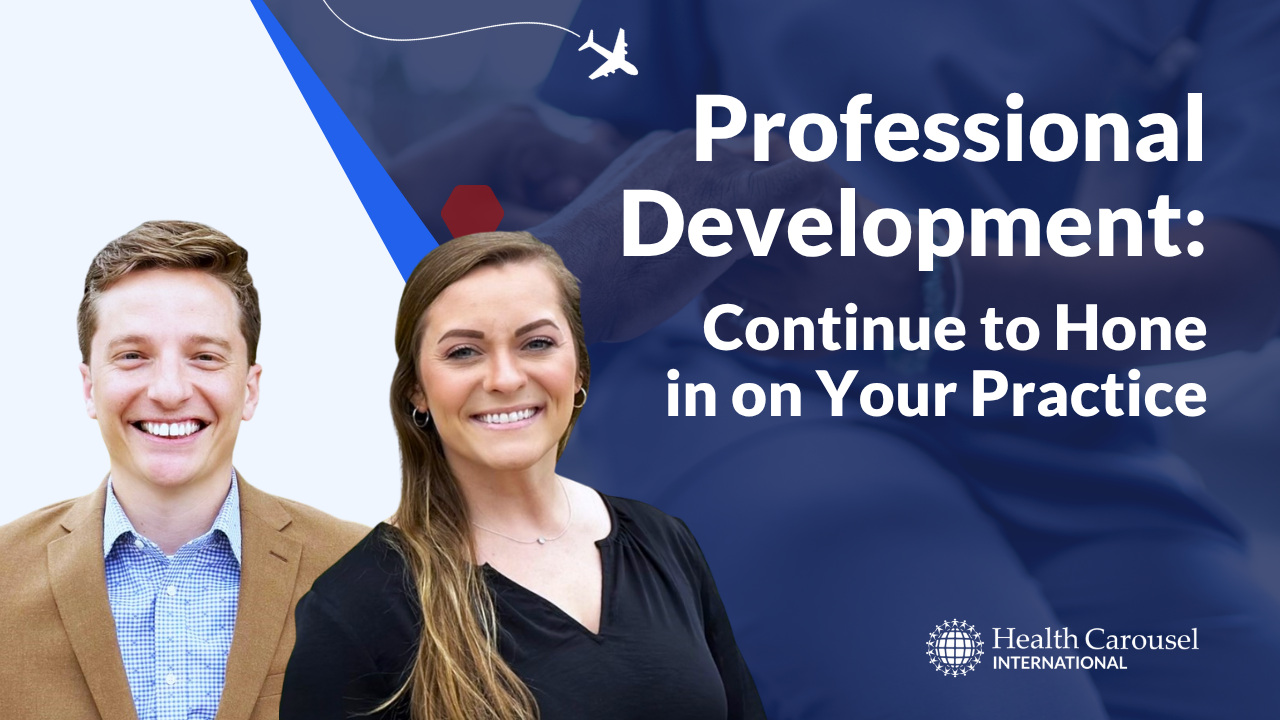
We have today, our discussion will be acute care and how that experience can promote really great professional development in your nursing career. So with me today is Ryan. So to get today, together, we will be reviewing acute care, what that looks like, and how it supports your growth. So, you know, I thought we could spend some time breaking down what acute care really is, what that looks like, why it's important to obtain that experience prior to coming here to the US.
No, and I love this topic, because acute care is really one of those terms that gets thrown around. But when you are actually at the bedside, it has a very real and very practical meaning.
Right. So I think now's a good time to define it. And so when we talk about acute care, we mean environments where patients are experiencing sudden, complex, rapidly evolving health needs. So medical, surgical, cardiac, neuro, trauma, etcetera.
And so because those conditions can change so fast, it puts the nurse in a position where clinical judgment and skill really do matter. In the hands, you know, in the moment, moment to moment work where you are assessing trends, anticipating complications, intervening early, being proactive where you, you know, you can have, the confidence to do the right thing is important.
Right. And so, Ryan, with your background in nursing, do you have an example that maybe we could discuss to kind of support this than like what we're talking about?
Absolutely. So my background, so prior to joining Health Carousel, I was working on a medical surgical oncology unit.
And so kind of going back to my roots, trying to think of a great example that we could use, right? You had kind of stumbled into the following situation here. So imagine yourself having a patient, we'll say a fifty six year old recovering on a surgical floor after a bowel resection earlier that day. Initially, the patient was stable, pain was controlled with IV pain medications, vital signs were within the normal limits, you know, subtle changes during the shift, right? You might imagine, you know, around four during this shift, the nurse noticed small differences compared to the start, right? The heart rate was creeping up maybe from the mid 80s into the one hundreds, low one hundreds. Blood pressure was still within normal range, but lower than earlier, maybe down from one hundred twenty eight over seventy eight to one hundred four over sixty six.
That's the blood pressure respirations up a little bit, maybe into the 20s urine output borderline low within the past couple of hours. The patient decreased.
The patient discussed an increasing abdominal pain that feels different than earlier.
Restlessness has set in, difficulty getting comfortable, skin slightly cooler and pale, and then finally the abdomen looks, slightly distended.
Individually, these might seem explainable after surgery, but together they definitely could suggest something is evolving. You know, what an experienced acute care nurse recognizes, would be, you know, that through their bedside experience and thinking through it, you know, they start to think about possible internal bleeding or early shock, not just postoperative pain or what may some of those individual signs or symptoms may just represent to themselves.
Post op tachycardia often is the first sign of bleeding. Blood pressure can remain normal for a while.
Restlessness is a very classic and early perfusion problem. Urine output is a sensitive indicator of circulation.
So instead of waiting for the next routine check, the nurse could perform a full assessment, check the surgical site and drains carefully for increased output, measure the abdomen for firmness and distension, review the intake and output records, recheck the vital signs manually, and then call the surgical team, right, with any specific concerns that, any of the assessment or changes in condition could, be leading the nurse to.
You might call and say, you know, his heart rate has climbed twenty points, urine output is falling, and his abdomen is becoming more distended. I mean, really describing that, having that information to provide to the surgical team, can certainly be a quick and early way to have the appropriate mentions to prevent further escalation or issues.
And so because a nurse escalated this early, they can get stat lab orders from the physicians to take that assessment further, becoming a little more invasive with the required orders that the physician has to provide. You might get a rapid fluid bolus ordered and started surgeons to evaluate the patient quickly.
Imaging can confirm if there is a postoperative bleed, and therefore the patient could get back to the OR for, the life saving surgery and corrections that are needed.
So why? So with someone who sorry to cut you off. So someone with, you know, without acute care experience, right, what do you think, might they miss?
Yeah, so someone that doesn't have that acute care experience, not experienced something like this, they might assume that the pain is what's causing the tachycardia or the blood pressure is still okay, so it's not really anything that needs to be worried about at this time.
Or that postoperative patients look uncomfortable, right? They may just be in some pain or having surgical incision irritation.
They may give more pain medication as a result, thinking that's going to fix the problem, figuring they can recheck on the patient later. And they'll document the vital signs without focusing necessarily on the trends that have been displayed. But unfortunately, you know, the next signs that would come after that could be like sudden hypotension, altered mental status, or, you know, potentially leading to a rapid response needing to be called.
For sure. And so, you know, I think that's a really good example to demonstrate, like, how acute care experience of any kind, right, is better than none. And so I think that's kind of like why bedside or acute care, you know, experience matters. And so, you know, something that we've emphasized lately, is just the value of staying engaged, right? At the bedside, in acute care setting, just the bedside care is just like that professional development engine.
No, absolutely. And it's very hard to grow clinically if you're not exposed to real patients with real needs.
Every shift that you work at the bedside taking care of patients can really lead to exposure to different disease processes, different presentations, different responses to treatments. The more exposure and experiences just helps you to set yourself up for success and really be aligned with the expectations of US nursing.
Right. And so, and that repetition like builds confidence, but it also you know, sets yourself up for that success, like you said.
Yep. The more you see, the more your brain really builds the pattern of recognition. Your assessment skills get sharper.
You anticipate patient needs sooner.
You feel more assured in your clinical judgment because you've lived the scenarios, not just read about them.
Yeah, absolutely. And so like that makes me think of when I first, like my background before coming to Health Carousel was mother baby unit postpartum. So whenever we'd get a small baby or an LGA baby, we would always check blood sugars on them because that's a risk factor of being born very, very small or very large. So I just remember, you know, in the beginning of my journey having, like, being getting an admission patient, knowing I'm gonna have to check blood sugars on these on these newborns.
And I would just like anxiety just immediately because, like, just would always think, like, worst case scenario. Like, well, what if the sugar doesn't come up? What if, you know you know, I get behind on all the other things I have to do? And so but as time progressed, more experience with those blood sugar babies, I felt more confident.
I knew kind of how to balance everything. I knew how to prioritize and not just, like, kind of be in that panic mode for when I would get a blood sugar baby on that admission. So it really does like, repetition does reduce that, like, fear, those what ifs, because, you know, you have proven to yourself that you can do it because you've done it before. So, you know, sometimes may you may think about, you know, when you've handled sudden drop in blood pressure in a patient, a patient who codes, like very high stress situations and unexpected unplanned.
So that adaptation and that response really builds a deep sense of resilience. So that confidence grows because you've been through unpredictable events like those and therefore proven to yourself that you can adapt. And so I think through time in acute care experience, as a nurse, the repeated exposure, kind of like you said, Rye, kind of like rewires your stress response. And that's exactly what happened in both like, at least in my situation.
Right? Once something felt overwhelming, but then begins to feel manageable. So that experience really does just tremendously improve your professional development in your nursing career.
And so the more you do certain tasks, the more intuitive you become. You become a mastery of that skill.
Then that then supports that confidence building. So your hands and mind just kind of know what you need to do without even thinking about it. Right?
And so it just becomes second nature.
So acute care nurses learn to identify subtle changes. And this is kind of going back and supporting your example, Ryan, of the story. So identifying subtle changes, escalating appropriately, anticipating complications, prioritizing multiple complex patients. All of those situations you have found yourself in through experience just keeps proving to yourself that I can do this.
And so one of the things that we often hear from nurses transitioning to US healthcare is that they're surprised by how much variety they encounter. And so, you know, that could mean, you know, patient, you know, situations, diagnoses, and also kind of all the things that the nurses are responsible for.
Yeah, I mean, care really is a spectrum. One day you might have a stable post op patient and the next day you're managing someone on multiple drips with respiratory instability and a dozen specialists involved.
One day never really looks like the next.
That mix with the patient assignment that you have, you really just sort of start to expect the unexpected, but your acute care and your exposure really comes into play and helps you.
Yeah, one hundred percent. And like you said, even if you have the same patient's shifts in a row, that doesn't mean they're going to be exactly how they were the shift before.
So absolutely, I think, you know, the there is a lot of variety just because humans are humans. Right? We're unpredictable at times. And so but I think the right that exposure helps with the adaptability. Right? And being able to adapt quickly like you need to.
Yeah, it'll help you to stretch your skills.
Certainly, you know, make you think critically and push you outside of your comfort zone, but that's a good thing, right? As nurses, if we're not learning, right, you're just sort of sitting still and time passes you by. So over time you develop a deeper clinical lens and you're not just reacting to the symptoms anymore. You're starting to understand the physiology behind them so you can help sort of predict what's next.
Yeah, like seeing the bigger picture, right? The whole picture of what's going on with your patient rather than focusing on what's right in front of you in that moment. And so, yeah, absolutely. And so the other thing that we often hear is the pace.
Right? The pace of US health care is fast. And so but a lot of times, like, you may wonder what makes it so fast paced, right, compared to maybe other countries. And so we have a great, use of technology.
Right? Very advanced. So a lot of things are computerized in some form or fashion. So electronic charting, monitoring systems, equipment and supplies and tools, right?
So the other part of that is, you know, very sick individuals find themselves in the hospital. And so we also have an aging population, here in the US. And with that comes an increase in chronic conditions. So a mix of those two things finds people in the hospital.
And leads to more complex patients too, because they have not just one diagnosis or one disease process, they have multiple. And so therefore the more complex the needs are, the faster, more intense the shift can kind of be, right, and the care that's needed for those patients.
So the higher patient acuity requires more intensive monitoring, advanced clinical judgment, and rapid escalation. So again, kind of referring back to what we've discussed so far, all of those experiences really do help you become, you know, the best nurse and really successful here.
So even system level initiatives emphasize efficiency, quality metrics, and accelerating workflow expectations. And so that's kind of on the facilities part of things. But those are kind of the expectations. And so efforts to reduce inpatient length of stay as well, right?
Because the patients don't want be in the hospital. They wanna go home. And so the facilities and the hospitals, of course, wanna support that, but also the more patients they get, the better it is for the hospital. So the efforts and care that's provided, as soon as the patients can go home, they're gonna get them out of there so they can get someone new who needs the help.
So patient turnover can be kind of speedy depending on the unit.
That also requires fast coordination with other teams, right? Maybe case management, social work, other specialties that are following the patient. So definitely lots of things to coordinate. And each transition of a patient, right, each admission, each discharge requires documentation, requires education, communication with not just the patients, visitors, families, also the other teams, like I mentioned.
So lots of time consuming things. And so all of those things combined really do, create that fast paced environment for US healthcare and nurses. So because of that, it can help your professional growth, of course. So if we think about professional development, right, we usually think about certifications, degrees, like the extra stuff.
So those that those are important.
But I think, you know, the acute care bedside experience is the foundation of all nurses. And so that's something that I think is a good reminder and a great motivation to gain that experience and exposure prior to coming here to the US.
No, you're absolutely right, Ashton. And all that is, I would definitely recommend taking that and digesting it and including it in your practice. You would build expertise by doing. That's a huge part of nursing.
It's very fast paced learning environment, but you certainly become proficient by getting to the bedside and starting to get those experiences under your belt. The perfect, to perfect your assessments, you got to get better with time management and you have to get better at prioritizing and you figure out how to communicate clearly with physicians at the bedside and their families all by experiencing those in real life. Those are things that will only come with experience and you will continue to improve as you transition your practice to the US. Not that you'll be perfect at them, right?
Nobody's perfect at anything. Like I said, in nursing, we're always learning. We're always having to dust off old skills and sort of learn how to reuse them. But certainly it becomes a lot easier and faster to get back up to speed when you're at the bedside accumulating the experience.
Yeah. And one of the things that I've shared with many of my nurses that I've spoken to is, like my clinical instructor in nursing school said like the best thing to me that I could have heard in my life. It's, you know, being patient with the learning process. Like that was feedback she provided me.
And it's absolutely true. Learning takes time. It takes repetition. And so starting as soon as you can will really just, again, make your transition to here in the US just that much easier.
So whether you are wanting to go and practice nursing in med surg, ICU, ER, L and D, whatever, that bedside acute care foundation is what ensures you're ready for the acuity levels we see across the US healthcare systems. So, know, so Rai, can you explain a little bit on like what US acuity, may feel like in practice?
Yeah. So before, you know, we've kind of closed things out here, you know, the crazy thing, you know, really with US healthcare is the acute patient care settings, right, continue to see an increase in the level of acuity of the patients they serve. It just seems like obviously you don't take care of the healthy patients and they look for ways same day surgeries are becoming more popular. Right? If you can get a patient in and get them seen and allow them to recover at home, the outcomes are much better.
And so in turn, you're really only seeing the sickest of the sick, I believe, as you said earlier.
And this in turn has hospitals focusing on ensuring that they are employing and developing nurses and other professionals with strong critical thinking skills and strong patient care foundation skills. Your assessment skills, your critical thinking is a priority.
And so all this being seen in the interview process is where the leaders focus in when they're reviewing candidates prior to offering them positions within their organization.
They look at things like nursing experience, current knowledge, and patient care abilities. And what they like to do is they'll tend to ask a lot of open ended questions, you know, really dive into the experience you've described on your resumes to make sure that, you know, entering into their care environments in the facility, you really are going to be able to take on that patient care that they see there at the bedside.
Yeah. Yeah. So great wrap up, Ryan. I think that really does kind of solidify everything that we have discussed today. And so for key takeaways, Right?
As we as we close out here, you know, bedside practice is professional development. Right? You are, through experience, gaining confidence, gaining, like, exposure to many different things. And so that is a way of growing.
And you should want to be uncomfortable in some way. Right? Because when you're uncomfortable, that means you're growing, means you're learning. And that's always something that that you should be motivated to to do.
So it's where you get stronger. It's where you sharpen your skills. Every shift makes you better because that's just more and more experience and exposure that you get. So the more you stay engaged searching for learning opportunities, that's always really great.
But the more prepared you'll be for the next step. And, again, ease the transition to US healthcare just a little bit easier as far as those expectations.
And acute care can be challenging. Right? Bedside work can be extremely challenging in various specialties. Right? They all have their own challenges.
It's also one of the most powerful ways that you can develop yourself as a nurse.
So with the bulk of our positions from our partner facilities, they are acute care. So those are the expectations they're going to need the nurses to have, right? That exposure, that experience to be able to adjust and transition to care for the patients we see here in the US in the hospital. I think the US is really great about having preventative care, having many doctor's offices available all over. And so we're really good at trying to keep people out of the hospitals, but at the end of the day, there's still going to be patients admitted. And so, again, that's the environment that many of our positions we have are located right in that acute care environment.
Yep, absolutely. You hit the nail on the head, right? And staying clinically active can open up more doors for more interviews, significantly elevating your resume. And really it benefits the patients too, right?
Skilled nurses equal improved patient care outcomes, Catching things early and being able to intervene appropriately. So I think it's a great discussion for today. I think it's a great place to end and hopefully this information is useful to everyone and can definitely be used in your preparation to transition your skills and your career to the United States. So thank you everyone for joining us today.

Related Resources

Planning for Transportation in the U.S.: What You Need to Know

Planning for Transportation in the U.S.: What You Need to Know
Keep Exploring More Resources
Looking for more guidance? Browse our full collection of resources to support you throughout your journey.
.webp)
.webp)