A Day in the Life of an OR Nurse
The Resource Center content, including all videos and other media, is for informational purposes only. You should not construe any such information or other material as legal, tax, investment, financial or other advice. The advice and information contained in the Resource Center is not a substitute for advice from a professional who is aware of the facts and circumstances of your individual situation
Summary:
An OR nurse from the Philippines shares her experience transitioning to nursing in the United States, including working on a cardiac surgery team in Virginia. She discusses daily responsibilities, advanced OR technology, supportive training programs, and the importance of teamwork, adaptability, and kindness when building a nursing career in the US
Transcription:
We are gonna go ahead and get started and start with our nursing in the USA segment. We're gonna take a deeper look into what it's really like to live and work and nurse in the United States because, obviously, that's everybody's goal.
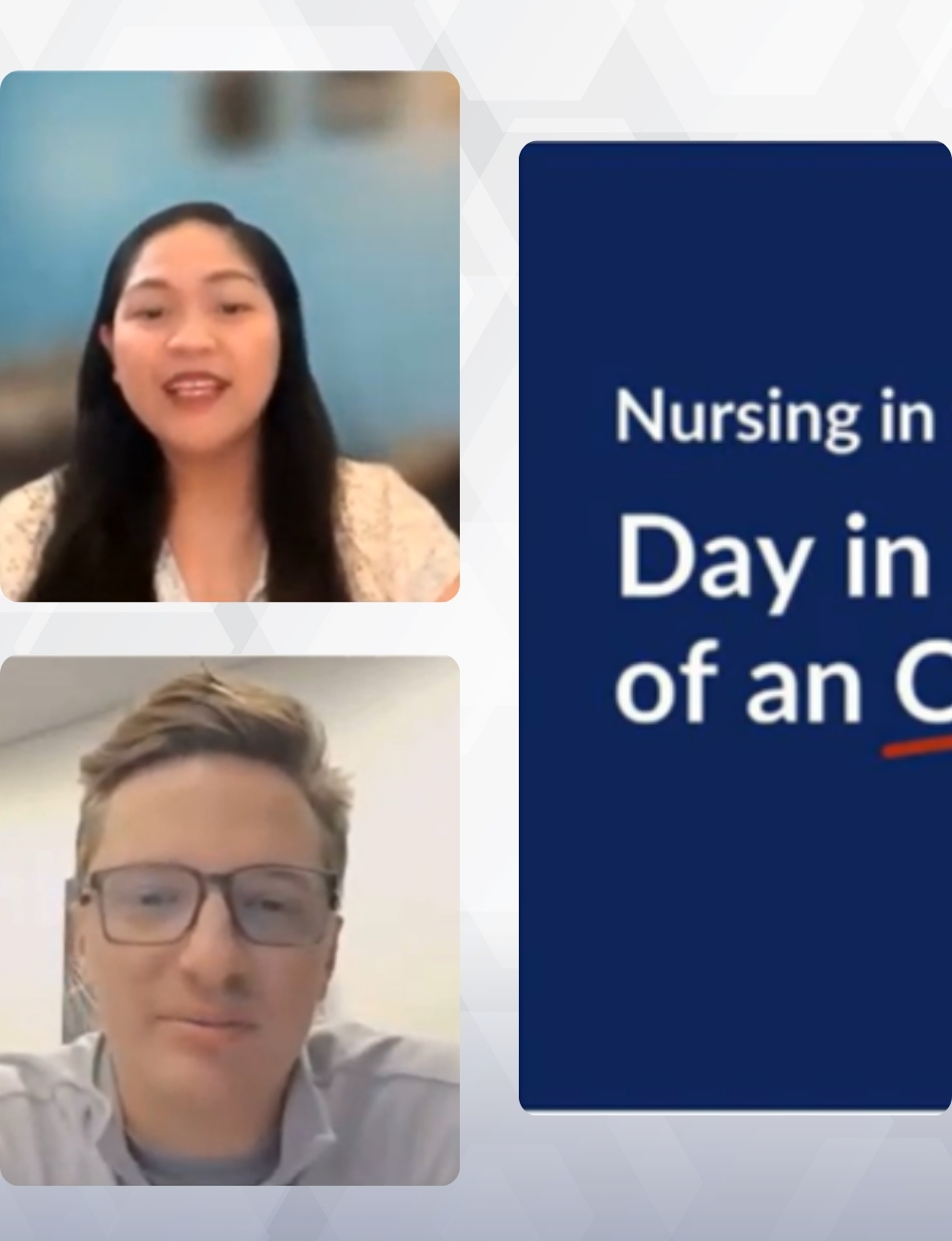
We know it's one thing to hear about the process. Right? It's one thing to hear the stories and the backgrounds, but it's another to hear directly from someone who has gone through it. We're gonna hear directly from Health Carousel International, Molly, an OR nurse who made the transition to the US and is now working and living here. She is joined from by Ryan from our clinical team, our Quinn team, who will be talking through her journey from her background and transition, going through her day to day and what it's like now as an operating room nurse. So we are going to hear directly from Molly about her experience, and I'm gonna let her and Ryan take it away.
Everyone, my name is Ryan Keefer, and I am one of the clinical support team members here at Health Carousel. During today's nursing in the USA segment, we are going to take a closer look at what it really is like to work in the operating room and perioper services here in the United States. I am joined by Molly, who is currently working as an OR nurse.
Hi, Molly. How are you? Thank you so much for being here with us today.
Hi,
My day is going great. It's also great to start it with this interview, and I'm very excited to share about my life as an OR nurse here in Virginia.
Awesome, awesome. No, it's definitely one of my favorite things that I get to do, know, sitting down and just having a casual conversation with one of our working healthcare professionals. And know, really, I just wanted to kick things off with just sort of getting a feel for, you know, from you. You know, what does, you know, a typical workday when, you know, you get to work, you get your, you know, your scrubs in you know, on and and you're you're getting ready to go? What does, you know, a typical day look look like for you?
So a typical day for me starts off pretty early as compared to some of my colleagues because I am part of the cardiac surgery team, and we work hard to get our cases started very early. It will depend whether I will be assigned to scrub in or to circulate a certain case.
We would usually start off seeing our patients, getting the back tables ready, getting the room ready. And when everybody in the team is ready to receive the patient, we roll back our patient and start off with the heart surgery that they need.
Awesome. So I guess, elaborate on that a little bit. I know you said you scrub or circulate, just really depends possibly on that. But how how I guess, walk me through, you know, when you when you are getting your cases, like, what does that process look like of sort of reviewing the cases for the day and sort of how is it determined maybe whether or not you're going to scrub or circulate?
So what determines whether a nurse will scrub or circulate a case is the assignments that the service line coordinator makes for the day.
So she teams up, two of us, one to either scrub or circulate. And then as a circulator, you are the one who gets to see the patient, do the interview.
Very important is we ask about mobility problems, last meal, if they were able to void that day, the medications that they take, metals in the body or any implants because we use ESU or electrosurgery units. We don't want to get burns on our patients, so we make sure to know if they have metals in the body.
Ask them if they have anybody with them today or on that day, and if they want us to call or text them when we start or give periodic updates throughout the case. The circulator manages the whole room, giving medications to the field, coordinating with anesthesia. We have perfusionists who operates the long heart machines, coordinates if we need to call other specific members of the team to be able to do the surgery. And from beginning to the end, the circulator manages all the records of whatever we do in the OR, and we also give the handoff to the ICU team who receives the patient post op. If I will be assigned a scrub or if somebody will be assigned as a scrub on that day, the scrub will manage preparing all the instruments on the back table, making sure all of the implants needed are also ready.
And that nurse or that scrub will assist the whole team on the field. That means they're the ones who don the surgical gown, surgical gloves, and they will be part of the team who does the or who scrubs in and keeps sterile to be able to perform the surgery.
Very cool. Very cool. So, really, you're not sure which one or which role you're going to do until assigned out, which I can totally see that, and sort of being, you know, prepared to do both going into the day.
And it sounds like you're very specialized with the cardiac team, which is super cool to be a part of of that team.
So when you started your position here in the US, obviously, you know, I would guess that there were some differences in things that you had to adjust to.
What were maybe some of the major or biggest differences from your previous nursing experience to now?
So the major difference is I left the Philippines where mostly my experience was in the cath lab and TCV, Not very much about general cases.
And then how we do with the medical records there is we did a mix of paper and, electronic records.
Over here in the US, when I got here, a very, very nice program, especially for us international nurses, that it benefited us in a way that they have this peri op program where they give us lectures, they orient us to the whole operating room from setup, electronic medical recording, and everything else on how they do things on a day to day basis.
It's like they give us the opportunity to immerse in all the specialties, which is really, really cool. You get to do orthopedics, pediatrics, neurosurgery, transplants, and everything you can think of in the OR. Plus, they have a lot of equipment, which we don't have back home, especially robots, different kinds of robots used in spine, used in general cases, used in thoracic cases.
And soon enough, the other services will also have robotics.
So it's it was very cool for me to see robotic surgeries.
We had the opportunity to be trained on how to how to put in the arms of the robot, how to drape it sterilely, and even how to connect which cords to which part of the robot.
And even if we have reps that come in for those surgeries, they still teach the nurses on how to be able to operate it and what to do in in case something doesn't go as planned.
So that's one of the major things. And, also, the EMR that we are using, it's very different from what we use in the Philippines. So they gave us the training to be able to do electronic medical recording. They made sure that we know where to go in case we need to do orders, in case we need to review details about the patient.
And the time frame that they gave us was really enough for us to be able to immerse in it before we actually use it.
So I guess those are the two things that that are that are very major on what I had to adapt to when I came here from the Philippines. And in terms of the specialty that I am in, so after you rotate during periope in the different services, you will be given the opportunity to choose which specialty you want. So since I already came from TCV or thoracic and cardiovascular team in the Philippines in the cath lab, which is also really related to the heart.
I I signed up to to be trained for the cardiac surgery team, and I'm very blessed to be able to train under them. I trained with really, really good circulators and scrubs in that team.
Like, I must say they are top caliber people who train me. And I am very lucky to be under them. And I when I finished my I think it's a six month long training for that specialty alone.
Yeah.
It takes, yeah. It takes six to eight months. Mine was, like, around six months. I am now officially part of the team and working also with other international nurses, who is also from Health Carousel.
There's a number of us in that team.
Awesome. Yeah. I I think a couple of, like, the key points that that you included there, you know, the differences. Right?
There's gonna be some differences in technology, but also just the flow and and sort of the leadership of the unit. It sounds like you're in a very strong facility in terms of their orientation and introductory process, which I'm glad, always so happy to hear about that, in addition to the the clinical support that we can provide over to you throughout your entire journey, but especially during that orientation process. I think that's important to note to anyone coming to the US is that in orientation in the OR, it's hard to compare to your peers maybe that are working, inpatient units. It's
it's typically going to be a little bit longer because there is so much that you're having to get used to not only, you know, hands on patient care wise, but the technology or just the flow and ensuring that everything is is being done, how the facility, you know, sort of wants it to be done.
So you kind of took a you know, took the ball and ran with it there, you know, which is great, like, going over a lot of, like, the orientation and training support that you've had.
Was there anything about, like, the US health care culture that surprised you? I know you talked about, like, the the charting and the the technology and things. Was there anything specific about your team culture or dynamics or just health care culture here in the US that maybe took you by surprise?
So in the OR, since there are different teams that cater to different specialties, I must say, like, most of the teams there have really, really good team dynamics. They work well with one another. But specifically on my team in cardiac, it is very, very similar to my team back in the Philippines. So the way that we worked there in the Philippines is not very different from the way they work here.
When we talk about, like, work culture, it's more of, like, really being able to talk to one another and coordinating everything before we start cases.
So there's a lot of talking going on, a lot of preparations for us to be able to say, yes. We are ready to bring this patient back, and we are ready to do this today. We have everything. Do you have everything?
Does our proficientist have everything? Does is anesthesia to ready, for the patient to roll back? And that's also the same, dynamics I've had with my team before back in the Philippines, which it was not very difficult for me to be able to adapt to team dynamics. But my team right now have their specific techniques on how they do things, and that's kind of where I had to even upstep myself to be able to be a better team player and be a good team member.
And I have been enjoying my time with them so much.
Everybody is really nice.
Everybody really wants to help out, and nobody wants to see you struggle or fail. So everybody's really got your back in the cardiac team, and it's such a great team to be with.
Yeah. I think that's one of my favorite, things about talking to, perioperative nurses is the tightness of the team, right, just the camaraderie that often comes with it. You spend a lot of time with the same team members, right, especially if you you are specializing into, you know, a specific team such as, like, the cardiac team. So it's always a huge win and and certainly brings a lot of joy to to what I get to do when when reviewing how things are going during your assignment.
So I'm sure that was a huge support to you, but, you know, during your training, your orientation, I know that can be a really just, like, a a heavy time. Right? There's a lot going on, and and the amount of information and and newness is certainly super high. But, what do you think helped you to succeed during that whole transition period throughout that that time?
So during orientation, I'm just transitioning from be being in the perioper program to becoming a member of the cardiac team, I was given primary preceptors, somebody who overlooks over every single thing that I do when working and gives me feedback whenever things are not as expected.
And I really like how they give me the feedback right then and there, but in a very, very nice way.
And it really made me learn a lot, like, about how I do things and how I can improve things. Right. So on a daily basis or actually on from one case to another, I am able to apply improvements. It's an ongoing assessment that my preceptors in the cardiac team have been doing, and it's really nice because the training is very heavy.
A lot. It's a very highly specialized surgical team. Or like cardiac is very highly specialized and a lot of things could go wrong. And how the preceptors there have been guiding me through is just really amazing.
That when I get off orient when I got off orientation, I was like, I could not believe I have took in that much, and they have taught me that much. And it has helped me to, like, evolve a lot from being just this a startup cardiac surgery nurse here in the US to become every day developing into a better cardiac surgery team member.
Very important also is that when we are scrubbing, it's a lot of skills that we needed to learn.
And even if I had experience, it's a lot of skills that I needed polished.
And my preceptor was amazing.
He did like, he started me off with the easy ones. He would let me do the easy ones and then guide me through or back me up with the harder parts of each case.
And then when I master one part, he adds another part that I get to do alone until I get to do the whole case alone. So he did not just let me he did not just drop me in hot water and, like, okay. Stay afloat. But he really did a an amazing job on how he tapered which parts I should learn first, which parts I can learn last.
And when it all came together, I felt like I had, like, a five hundred percent boost of confidence in myself that, oh, yes. I can do it. Because he has taught me every single part and made me understand everything that I have been doing and gives me and I really love it how I am being given feedback on every after case. Like, we talk.
We sit down. We talk about it. We talk about things that have happened and things that I could improve on on the next case.
So that was I must say, like, my training here, knowing that I came from a different country and trying to adapt to how they do it here.
Everyone has been very helpful, and I think that or I can say that they really set up their trainees to become successful team members eventually.
Right. Right. So the value of a like, a good preceptor, right, someone who truly just become your mentor, and I think that applies to, nursing across the board, right, in in terms of unit and specialty is your preceptor oftentimes becomes sort of your your work pal. Right?
They continue to be your mentor beyond your orientation. At least, you know, when I look back to when I first started in nursing, that that's certainly how it was, and the culture that we tried to promote in the workplace was one that, you know, your preceptor is, you know, sort of your your mentor beyond orientation. So, certainly, you know, that is a huge plus, and I'm glad that that's been your experience so far. And I'm happy to hear that you have the openness to the feedback.
Right? I I would stress I stress it to to every nurse. Right? Whether you are new in the profession, you've been there, you've done it, being open to feedback is so important.
Right? Not only because in health care, things are constantly changing as to what the best practices are, but, we're not masters of everything. And oftentimes, skills get a little rusty. And so to be able to to take that feedback, you know, sort of whether it's presented in a, you know, a a, you know, nice soft way or maybe it can be a little blonde at times in nursing as well.
Right? Just knowing the feedback, right, the constant feedback is designed to help to improve and get you to where not only, you know, this facility want you be, but you yourself as a professional. So it sounds like that certainly went well for you.
So I know we only have a few minutes left here. I wanted to kind of get one last question in. And so, really, what advice to other perioperative nurses would you have that are looking to come to the US and work in in the OR?
Advice for those who are about to come here. I know everybody outside the US who are about to come here are already experienced, especially on what field or facility that they are going to get matched. But I hope everybody will remember that first, it's going to be a new country.
Almost everything is going to be new or different from what we are used to.
And having an open mind and an open heart to what they're about to encounter here is the first step for me or a first step that they could take because that's what I also set my mind and my heart on before I landed on American soil
That I will just be open to anything.
Be open to anybody as well, whether or not you would eventually like them. Because every person, every step of the way is a learning opportunity to be able to easily adapt on this new country that we are in.
Enjoy is the second one.
Enjoy the process.
For most of us, the waiting process is very long, tiring, and exhausting.
But the moment you leave your native land and come over here, set your mind to enjoy every step. Like, traveling is very exciting, but we can make something enjoyable out of it. Think of ways that you will be able to enjoy the long travel.
And when you come here, it's gonna be like, finally, another new chapter, another new beginning. And I will make memories out of this by joining a certain facility and being able to help other people by doing surgery, by being a periope nurse. And every day, may it be rough or may it be a happy day, enjoy everything and take in everything as an experience that will help you for tomorrow.
Right. Right. No.
I that's extremely valuable for sure.
And third one, last but not least, is be kind.
Because kindness resonates in always, always. So if be kind to yourself, first of all, because it's not gonna be easy. It's gonna be hard, so don't beat yourself up.
I learned from this. I did beat myself up at the beginning because I had the thinking that, oh, I wanna be one of the best. I wanna be a really good nurse, and I cannot mistake make mistakes. But if I I also learned that if you keep beating yourself up, it's not gonna help you.
But instead, if there are if there are times that you are off, like, a little bit off from being yourself. Try to be patient with yourself because you are learning. Be patient and be kind to yourself if you're not catching up as fast as you expect yourself to be or others expect you to be because everyone has their own timing. So if you are kind to yourself, you are able to resonate it and also be kind to others.
Because if you are kind to others, you are able to work with them in harmony.
You can have good work dynamics with them. Plus, the best thing is you can resonate kindness when dealing with your patients as well.
You are able to embrace them as somebody that you are prioritizing and taking care of in that day. Because surgery, you just see them when they come in, and it's goodbye when they come out of the operating room. You don't see them anymore tomorrow, not unless they they're being brought back. But that does not happen all the time.
So kindness will just encapsulate everything for you to be able to work in the perioperative field where there's long hours of standing, exhausting cases, and just trying to be kind and always, always is gonna help you a lot to be able to pull through within the day, weeks, months, and many, many years from when you start.
Absolutely.
Yeah. I I I can't say enough about how valuable those pieces of information are. And so, I know you had a strong background in perioperative nursing prior to coming to the US. It sounds like you've leaned on a lot of your prior knowledge. Would you say that that was a big help to you, you know, having the bedside experience prior to coming to the US, especially in a specialty like the OR, right, where where there's so much skill and knowledge that's needed?
Would you encourage your your colleagues, you know, looking to go on a similar journey as yourself to, you know, get to the bedside and and start gaining that experience?
So before I became an OR nurse in the Philippines, I have practically rotated most of the areas in the hospital.
I've had critical care nursing experience. I've worked in the wards.
I've had experience L and D, somehow helped up in the emergency room.
And I did some clinical teaching too. And that's just because I wanted to immerse myself in a lot of things and try to find what I really wanna do for the rest of my nursing career. And I think getting all of the things sorted out, I tried to learn everything cardiac related, made it be in theory, in practice.
And when I came to the US to become a cardiac surgery nurse, I came to realize that those experiences that I've had before, even infection control, they have all prepared me to be where I am today.
If you have knowledge and skills, that's really a great a great thing to pack up when you leave because it's not easy to just look at pictures, read the books, and try to go into periope and not really realizing what periope is. Right. I yes. I think having knowledge and skills is a big plus.
Although some facilities, just like where I am right now, they have a long, period program wherein they teach you almost everything.
But it's an advantage if you have experience with you because that period of program becomes the polishing of what you already have in you.
Yeah.
And I think So I strongly encourage No.
No. No.
I strongly encourage I strongly encourage nurses to be able to get experience. Like, immerse themselves in in the clinical field before they come here to work, in hospitals because it will really help you a lot.
Right. No. Absolutely. And I think it's important not to assume that every facility will be as great as the one that you're at as well too in in terms of training and expectations. So well, I wanna thank you for your time. I know we're gonna, have to run. And so, again, I I love these conversations, and we'll talk to you again soon.
Thank you for having me.

Related Resources

Planning for Transportation in the U.S.: What You Need to Know

Planning for Transportation in the U.S.: What You Need to Know
Keep Exploring More Resources
Looking for more guidance? Browse our full collection of resources to support you throughout your journey.
.webp)
.webp)